Let us know what you think on the LinkedIn version of this newsletter!
This month’s Athena Alliance / GEC Risk Advisory LLC Ripped from the Headlines Salon of approximately 35 members focused on the US-China relationship being at a global inflection point. This discussion has become ever more relevant and urgent given the importance of the President Xi, President Trump Summit in Beijing last week. Hence, a large majority of the Athena Alliance Ripped from the Headlines attendees voted to talk about this subject out of a total of 5 current topics.
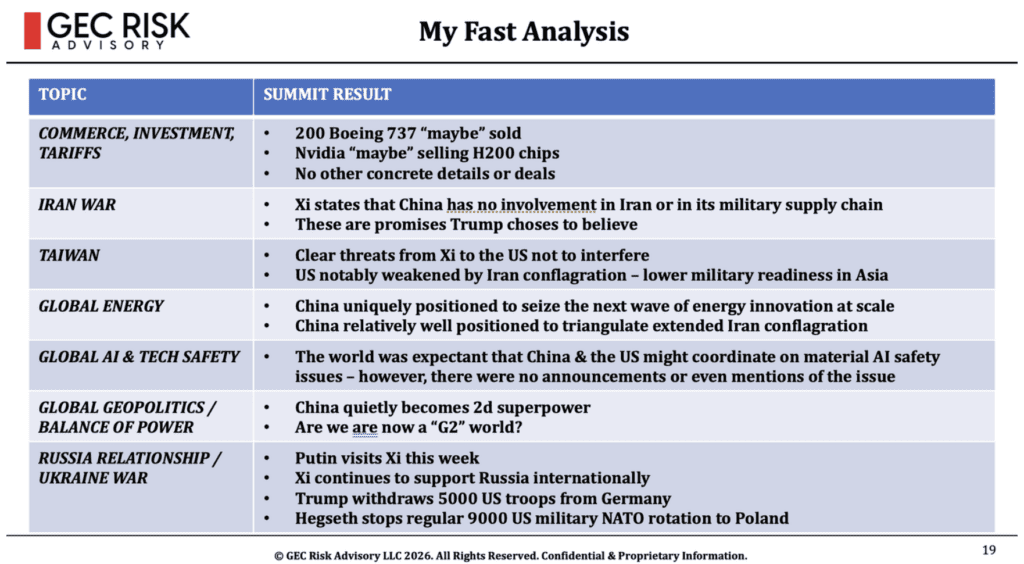
I presented a series of news headlines from what I consider to be reliable sources of news and analysis – the New York Times, The Washington Post, the Economist, the Financial Times, the Guardian, The Council on Foreign Relations, The Atlantic and summaries of issues covered and results that I asked Claude to glean from these and other resources. I also presented my own quick take on the Summit (see below).
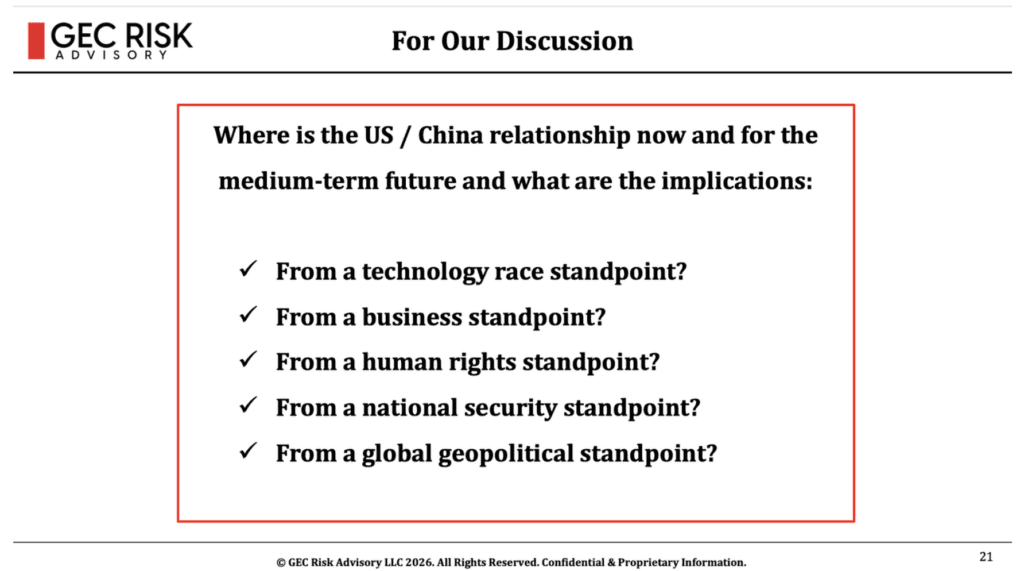
The question we considered for our off the record, Chatham House rules-based discussion for the remainder of our hour together was the following:
The discussion centered around the overall sense that many observers and experts seem to hold that China appears to have achieved its long-term strategic objective: reaching equal superpower status with the US, with implications for technology, business, human rights, and global geopolitics. Indeed, Trump himself in an apparently jocular tone said that there didn’t need to be anymore G7 or G20 meetings, only G2 (the US and China), lavishing praise and compliments on President Xi throughout the visit.
Salon participants shared concerns about China’s expanding influence in voids left as the US steps back from (or reassesses its role in) international organizations like WHO, the UN, NATO and other actual or potential alliances and pacts around new issues such as AI governance and cyber. Meanwhile, China seems to be following a long-term strategic path of establishing greater hard and soft power especially in the vacuum left by the US in many areas.
The group discussed the implications of the US withdrawal from WHO and the cancellation of USAID, particularly in the context of ongoing global health crises like the Ebola outbreak in the DRC and the still mysterious but concerning Hantavirus outbreak on a research ship in the southern Atlantic Ocean.
The group also discussed the strategic importance of Taiwan and its relationship to semiconductor supply chains and the issues of democracy worldwide.
Participants emphasized the need for critical thinking in navigating misinformation and the importance of educating young people (and frankly older ones in positions of corporate and other organizational power) about these complex geopolitical issues.
I led a discussion on US-China relations at a global inflection point, analyzing recent developments from President Trump’s visit to Beijing. We reviewed some of the key outcomes including apparent commercial deals for Boeing and Nvidia that were unclear in their details, and the absence of discussions and/or substantive agreements on major issues like Taiwan, Iran, AI and technology controls.
The discussion explored whether China and the US are moving toward a more bipolar world or a multipolar one with emerging powers like Russia, Europe and the so called emerging “Middle Powers” playing significant roles. I shared the below graphic I put together querying whether we were moving into a fundamentally different global order:
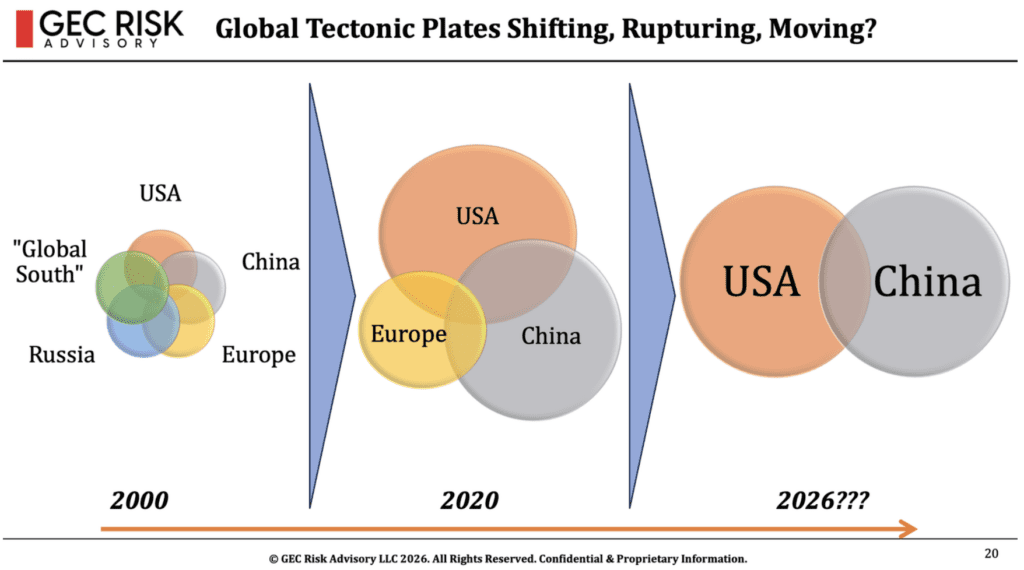
One of our participants raised concerns about the potential impact on US-China relations if the US shifts back toward a more democratic and inclusive political stance after trending toward a more centralized executive power structure. Another participant responded that while current personalized relationships between leaders may seem warmer, a return to traditional US government administration could lead to more orderly negotiations and risk management, particularly on issues like AI security. Another participant shared examples of China filling the void left by USAID’s demise, including the cancellation of RightsCon in Zambia due to Chinese influence, and expressed worry about the breakdown of bipartisan support for national security issues.
A participant discussed the importance of international rule of law and middle powers, referencing Mark Carney’s Davos speech and suggesting that I update my diagram (above) to include middle powers. She highlighted risks from the US’s withdrawal from WHO, particularly in relation to the current ship-based Hantavirus health crisis. She emphasized the need for strategic thinking about repairing international relationships and regaining trust, noting that both the Republican and Democratic parties are navigating significant internal pressures.
A participant shared her experience of being contacted by a Chinese talent acquisition specialist offering a fully funded program in China for PhD holders, which she compared to the US Department of State’s Tech Woman program. Another participant discussed her former experience with a leading US tech company in China, where she witnessed attempts to reverse engineer the company’s technology and expressed concerns about US companies potentially losing intellectual property to China.
The group discussed broader geopolitical issues including China’s soft power efforts, the situation with Taiwan, and the impact of US withdrawal from international organizations like the WHO on global health responses. The participants agreed on the importance of critical thinking and educating others about current geopolitical challenges.
Key Takeaways & Actionable Steps
As we always try, we attempted to be as positive as we can given our limited powers to change the course of policy making and international relations. Here are several constructive suggestions made during our discussion: