Let us know what you think on the LinkedIn version of this newsletter!
July’s meeting of the Athena Alliance / GEC Risk Advisory LLC monthly Ripped from the Headlines Salon focused on the state of global democracy and its business implications, with a particular emphasis on recent and forthcoming elections and political developments, especially in the U.S. as it celebrates its 250th anniversary.
I presented data from a variety of reliable sources both thinks-tanks like V-Dem Institute Freedom House & The Economist Intelligence Unit (EIU) that focus on tracking the quality of democracy worldwide through meticulous longitudinal analysis – and periodicals like the The New York Times The Economist & the Financial Times.
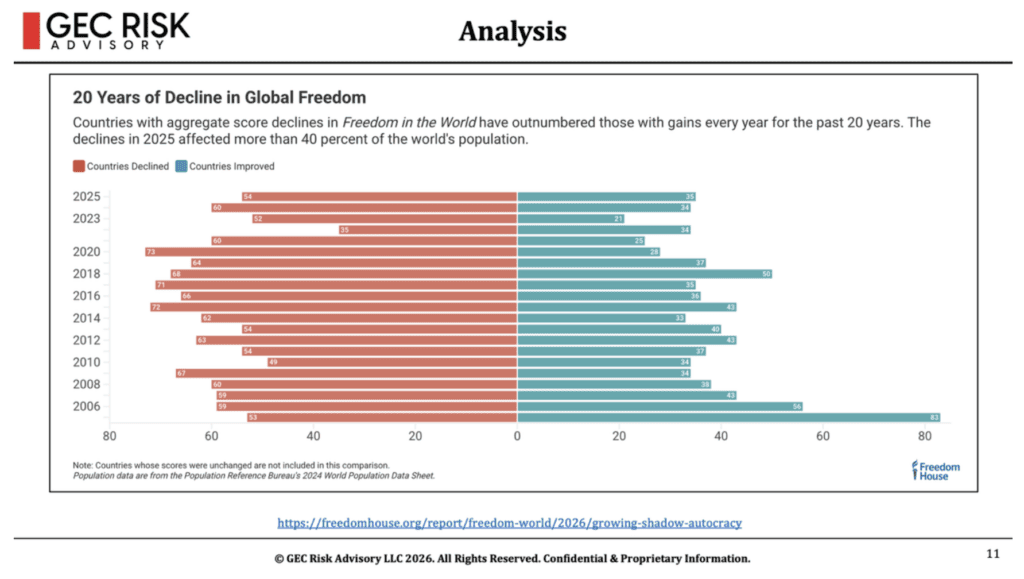
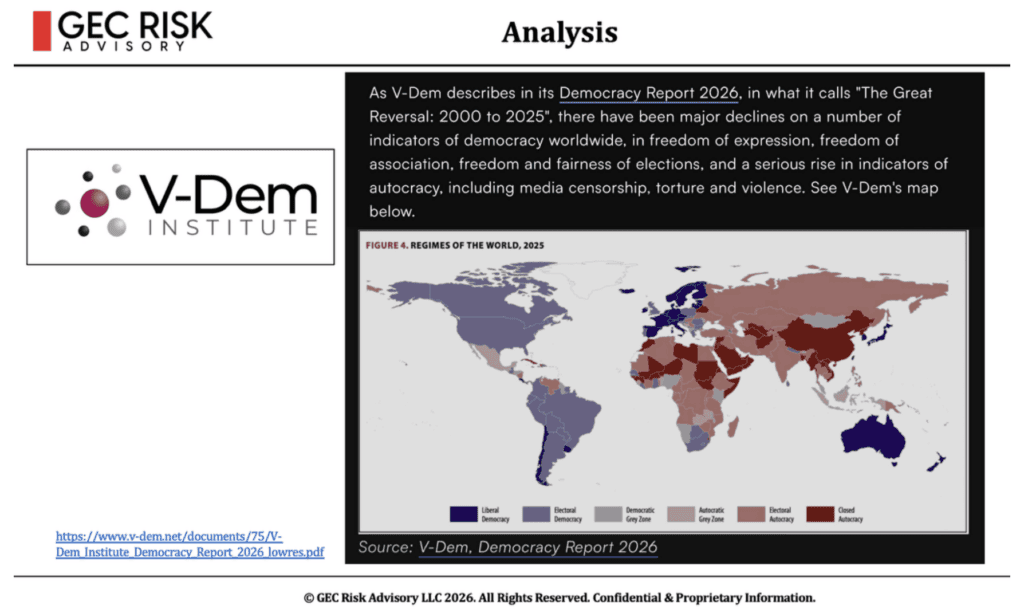
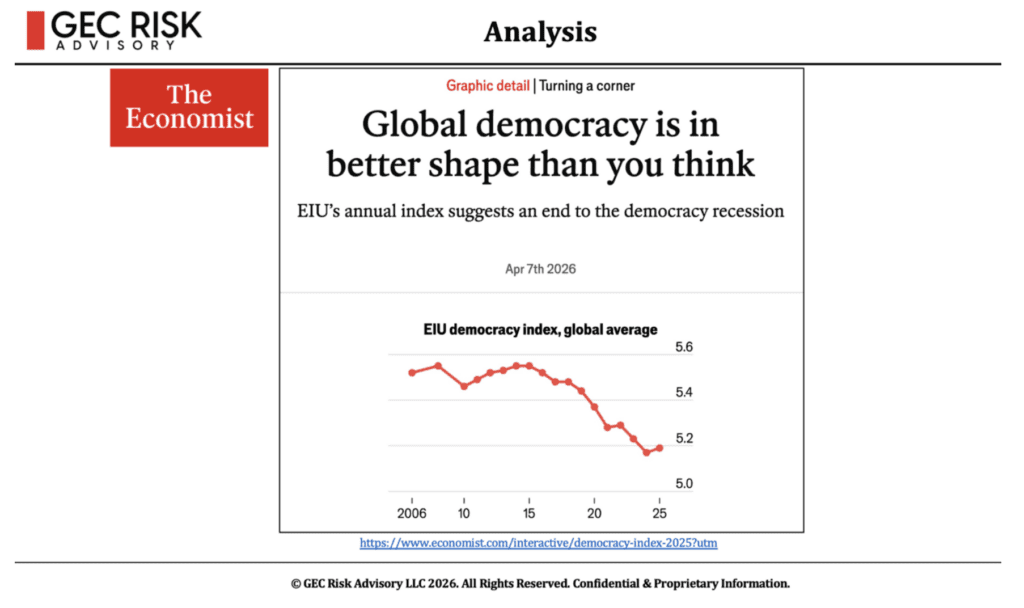
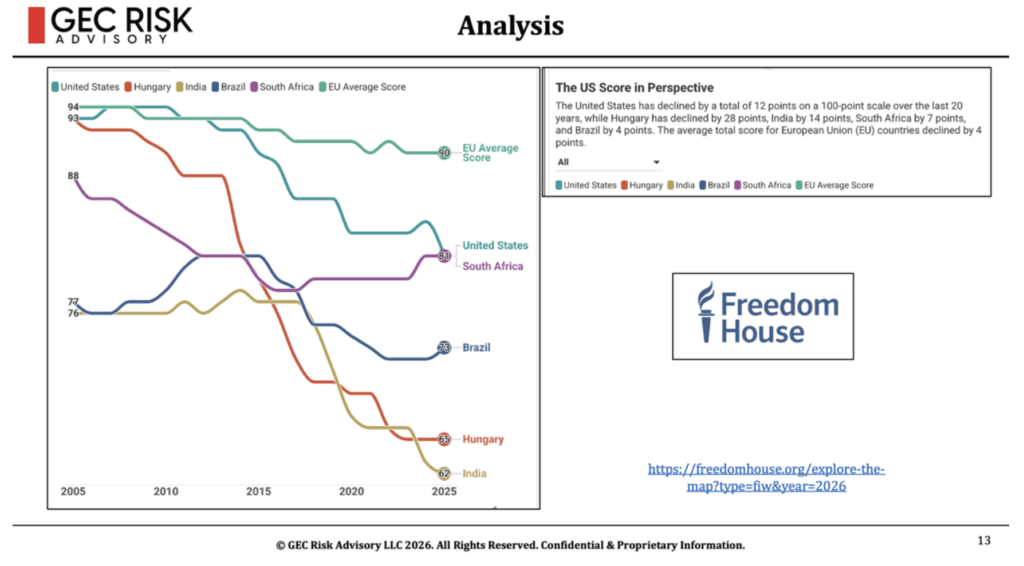
The first two think tanks – V-Dem and Freedom House – underscore the continuing two- decades-long decline of both the quantity of democracies and the quality thereof. See their graphics below.
While agreeing with the overall declining trend-lines of the other think tanks, the EIU is slightly more positive on the short-term – registering an apparent uptick recently in democracy worldwide. See their graphic below.
I also referenced my new article in the 7-part series – The Global ESGT Megatrends 2026-2027 – called “Megatrend #1 Grinding Geopolitical Tectonics” – in which I select “worldwide democracy in decline and at risk” as one of 3 key sub-trends in this Megatrend. See graphic below.

Below is the question we addressed in our off the record, Chatham House Rules based discussion. As always with this group, we emphasize the ability to speak our mind and express our opinions without disrespecting anyone else’s, and we try to accentuate positive outcomes, focusing on what each of us can actually do in our workplace and communities to tackle and solve the challenges we are facing (see “Practical Take-Aways” section at the end of this blog.)
The group discussed the erosion of trust in US elections, the influence of misinformation, and the role of the current administration in shaping electoral integrity. Participants shared perspectives on voting access, corporate responsibilities, the impact of money and technology on democracy, and the challenges of voter mobilization.
The conversation also touched on lessons from other countries (including Hungary’s recent major democracy improvement), the need for practical solutions to improve voter participation, and the broader societal divisions driven by economic inequality and political polarization.
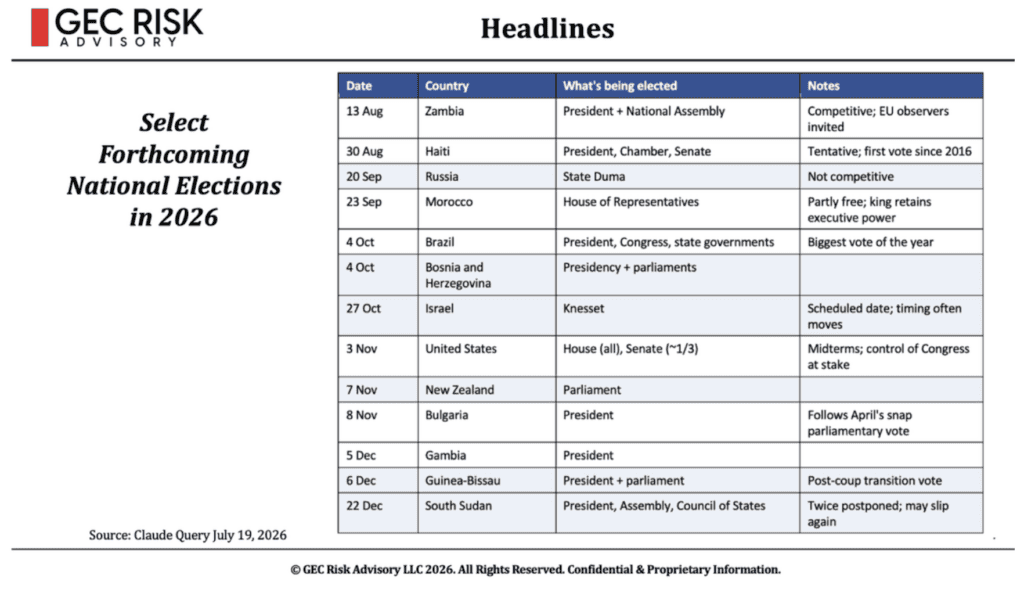
The discussion included analysis of upcoming elections in various countries and their potential business implications, with particular attention to the November 2026 US midterm elections and the October 2026 Israeli elections. See graphic below listing the remaining major national elections that are still upcoming through the end of 2026.
I presented on the state of global democracy, highlighting concerns about declining democratic indicators in the US and around the world. In sharing data from V-Dem, Freedom House, and the Economist Intelligence Unit, I showed that while some countries have improved, many democracies are declining, with the US score dropping from 93 in 2005 to 81 currently under the Freedom House analysis. See below.
An important discussion took place around voter identification and access concerns, especially throughout the United States in our upcoming Congressional and Senate elections. A participant emphasized the importance of free and fair elections and suggested actions individuals and corporations can take to support voting, including educating others about early voting and helping people obtain IDs. A key theme we discussed was the low and declining trust by the American population on the possible outcomes of the November 2026 elections. See graphic of a YouGov/Economist survey below.

Several participants highlighted challenges faced by people of color and students in accessing voting rights, particularly in states like Texas. Another participant reflected on the complexities of the U.S. election system, noting both its potential vulnerabilities to manipulation and exploitation by ill-intentioned public officials, on the one hand, and security benefits because of the decentralization of the US voting system, on the other.
The group discussed strategies for protecting and strengthening democracy, particularly in response to recent trends toward authoritarianism. One participant shared insights about Hungary’s democratic trajectory under Orban and compared it to current challenges in the US, while participants discussed the role of corporations in supporting employee voting and maintaining political neutrality.
The conversation highlighted concerns about the influence of undisclosed political donors and tech leaders in politics, with participants suggesting that responsible corporate leaders should address political discussions in the workplace transparently and consider ways to promote voting accessibility beyond just time off work without politically or ideologically influencing their workforce.
Athena members can access the full recording of this salon conversation here in the Athena library. Not a member? Let’s talk.