
Let us know what you think on the LinkedIn version of this newsletter!
Though we had chosen Geopolitical Developments for our second Salon of the year in February, I decided not to put our discussion to a vote this week (we typically survey our members for a hot topic), given the dramatic events that erupted on February 28th with the Israeli and US bombardment of Iran and decapitation of the long-ruling leader, Khamenei.
Instead, I unilaterally chose our topic for our monthly Athena Ripped from the Headlines Salon topic this month, as there is nothing more impactful than the dramatic start of a new regional and international war with large reverberations and potentially much more material medium and long-term global implications.
With the help of Anthropic’s Claude, I designed a visualization of the many layers and concentric implications of this unfolding, multifaceted and complex event. See the graphic below.
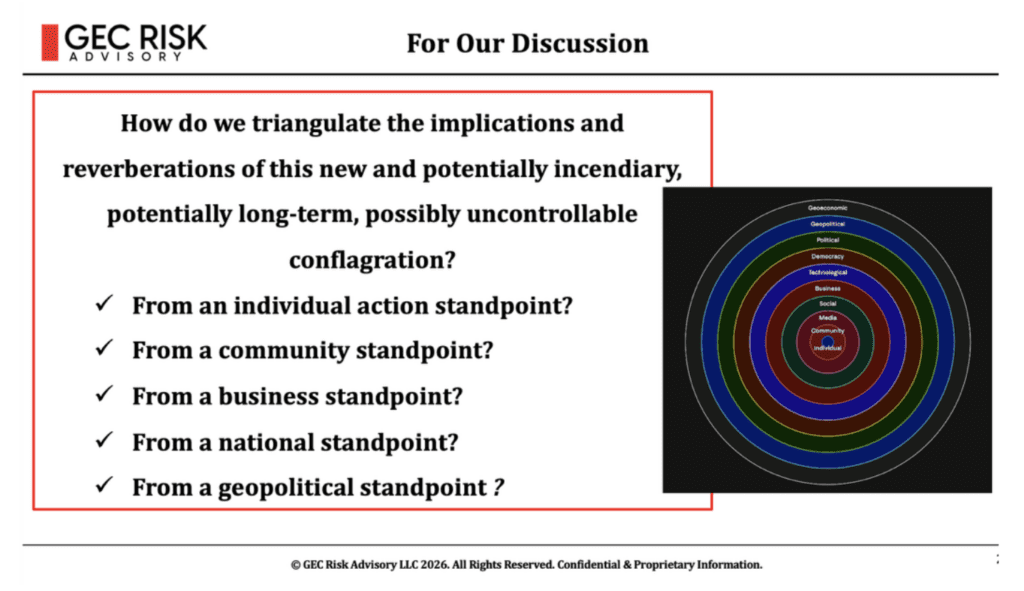
Below is the question we addressed as well as the key take-aways from our discussion, which is always under Chatham House Rules, not for attribution.
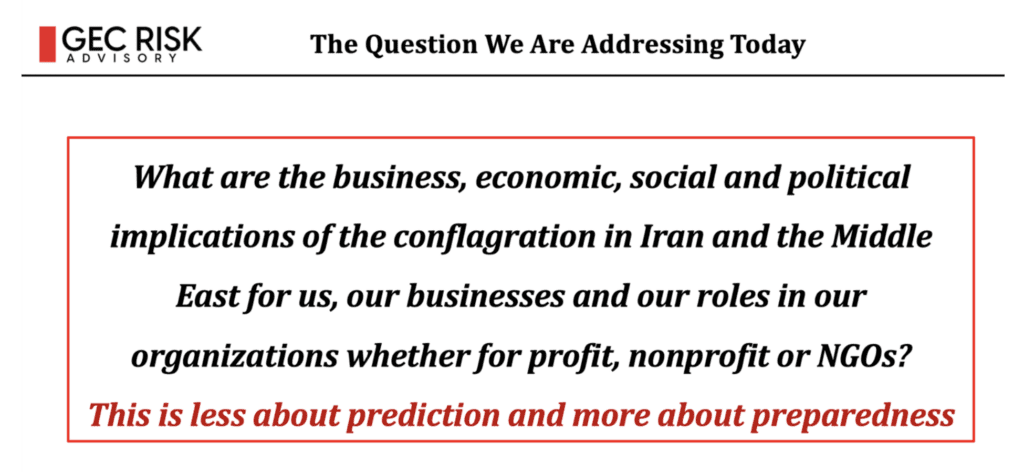
I presented news and analysis from what I consider to be reliable sources – the Economist, the Financial Times, The New York Times, the Council on Foreign Relations, CSIS, the World Economic Forum – focused on the geopolitical, geo-economic, social, technological, and business implications of the U.S. and Israeli strikes on Iran.
Regional and Global Geo-economic and Geopolitical Instability
The discussion covered how the war has created regional instability, affected global energy markets, and raised concerns about nuclear program security, with participants examining both the immediate consequences and longer-term strategic implications.
Indeed, there is no part of the world that is not affected at least by energy prices and supply chain issues.
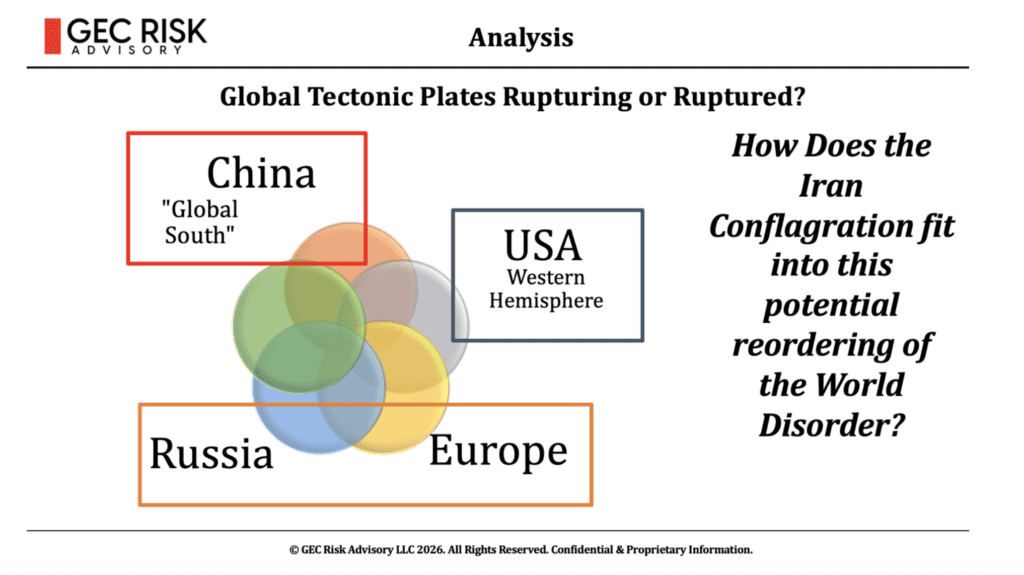
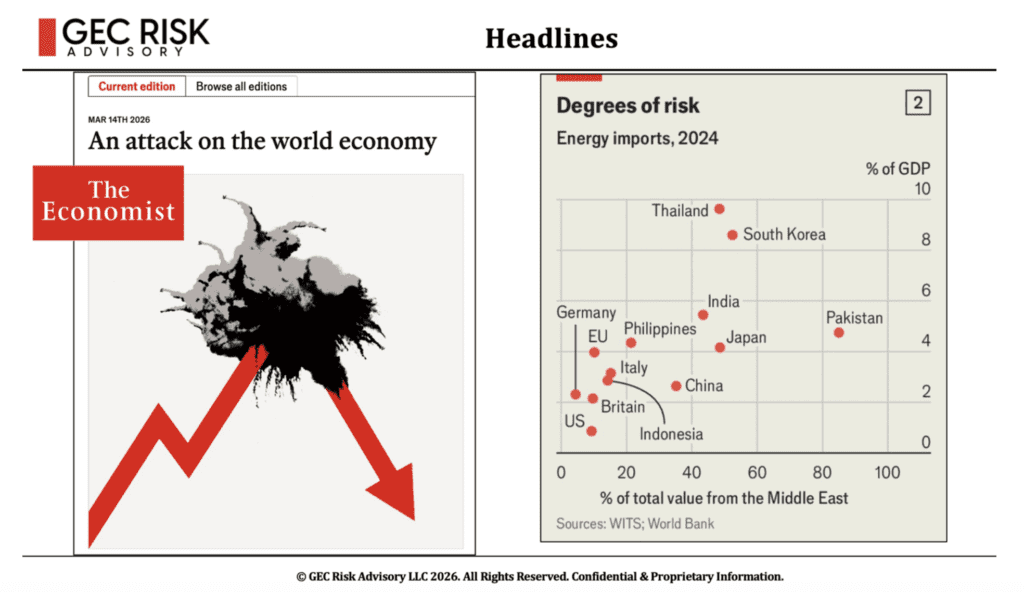
Below are two slides I presented, which we also discussed in terms of where the geopolitical tectonic changes we are experiencing will head and what the relative impacts of the current geo-economic disruption are on different parts of the world, as illustrated in The Economist’s in the second slide reproduction below.
The discussion also touched on domestic political issues, including the potential windfall for U.S. oil companies and the threat to media freedom from the FCC chair. Participants emphasized the need for preparedness rather than prediction in the face of this global conflagration and encouraged participants to explore resources for further understanding the situation.
One participant emphasized the need for corporate leadership to step up and serve as a unifying force during times of political disruption, while other participants discussed the breakdown of norms, the role of corporate boards in addressing these challenges, and the broader implications for global stability and U.S. leadership.
The conversation included participants sharing perspectives on how individuals and organizations can navigate these turbulent times and work toward rebuilding stronger democratic and institutional frameworks.
The group discussed the current state of American democracy and corporate responsibility, focusing on the need for rebuilding and reform. The discussion highlighted concerns about the current administration’s approach and its impact on global alliances, the economy, and domestic policies.
Participants debated the role of corporate boards in addressing political pressure and the need for stronger guardrails in governance. The conversation also touched on the importance of investing in alternative energy and the role of the judiciary system in upholding the critically important guardrails of the US system of laws and regulations.
The group agreed that there are several things that we can all do that are within our control: