
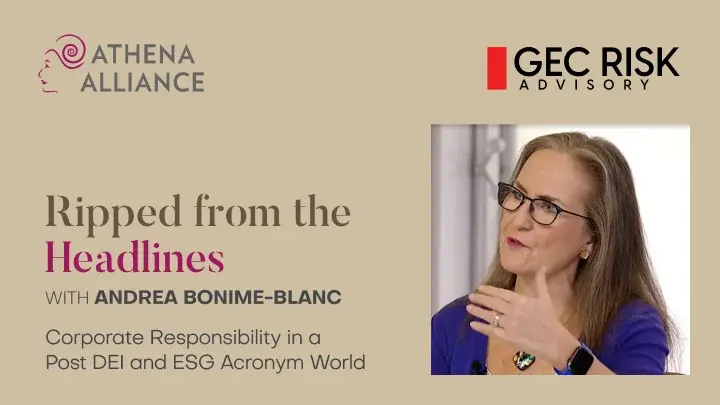
By Andrea Bonime-Blanc
Let us know what you think on the LinkedIn version of this newsletter!
Our first Ripped from the Headlines Salon of the year focused on where corporate responsibility and sustainability trends would be going in 2026 in a post-DEI post-ESG acronym world. I presented some recent relevant headlines involving both anti-DEI/ESG and pro DEI/-ESG stories as well as key developments and insights from various sources including regulatory actions and industry responses.
Our discussion covered regional sustainability priorities, the intersection with geopolitical risks and trends, and technological challenges. We also highlighted specific corporate examples like that of Microsoft who just announced a US-based AI infrastructure community-centric plan and The Conference Board’s recent CEO priorities survey report findings which has significant findings on both topics.
The group explored how companies can effectively implement and live their values through diverse leadership and strategic sustainability initiatives, with particular attention to reporting structures and long-term investments despite political change.
Below is the main question we addressed in our discussion.

ESG Trends and Corporate Responsibility
I started our discussion by highlighting key trends and developments in ESG and DEI, presenting headlines and trend lines from various sources, including regulatory actions, corporate responses, and industry-specific impacts. The discussion included an example from Microsoft’s announcement of a community-first AI infrastructure plan, which aims to address concerns about data center construction and operation. Below is a reproduction of what Microsoft announced this week.

C-Suite and CEO Takes on ESG and Corporate Responsibility
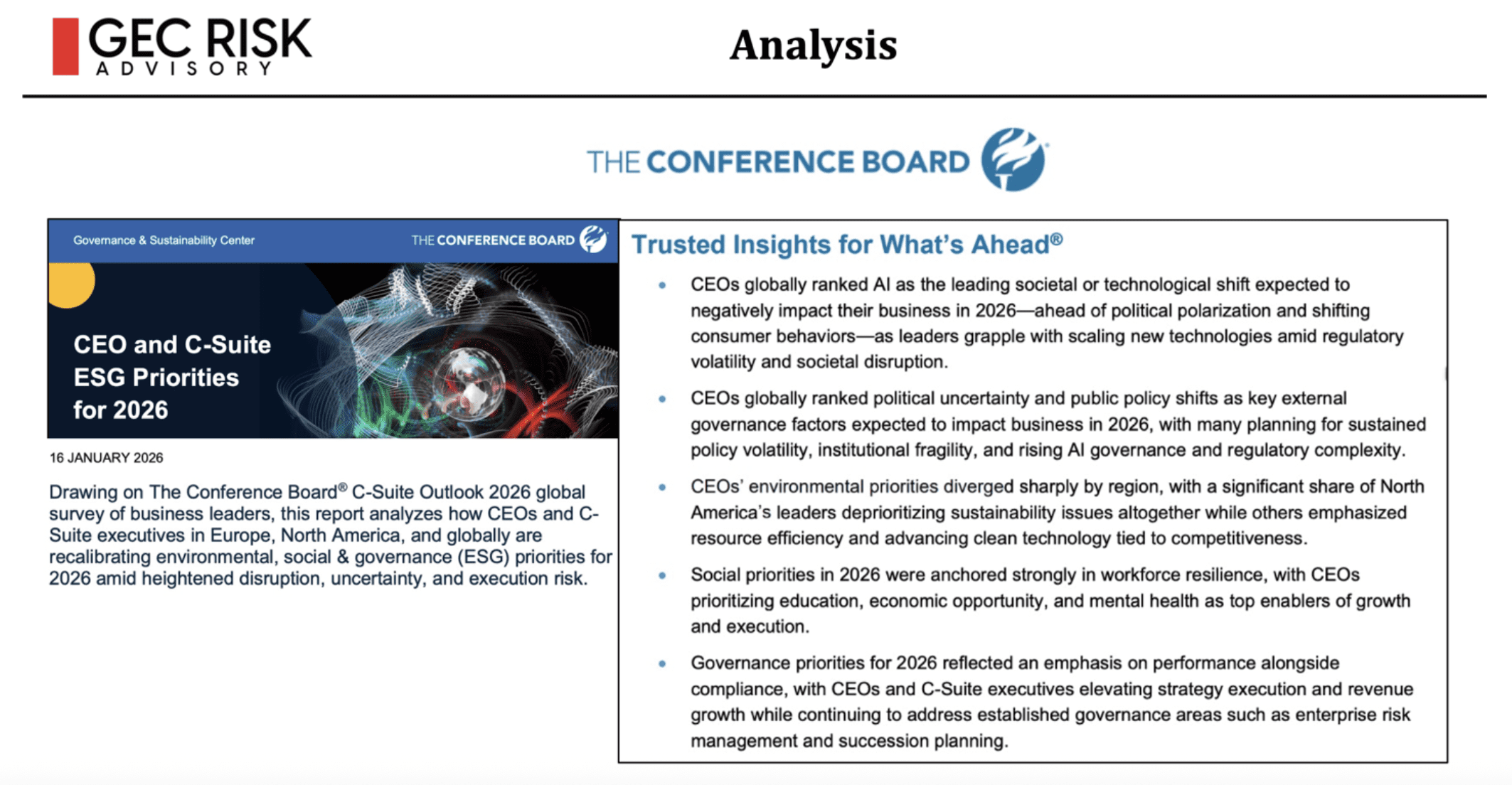
We viewed a short video from The Conference Board’s principal researcher, Andrew Jones, presenting insights from The Conference Board’s recent report. Key trends discussed included AI as a governance challenge, diverging sustainability priorities between regions, and a focus on social issues like education and mental health. The group also reviewed the World Economic Forum’s Global Risks Report, highlighting geopolitical and geoeconomic risks, as well as environmental and technological challenges. Below is a summary slide of the findings of this report:
Promoting Diversity and Inclusion Internationally
A participant who works extensively in the Asia-Pacific region and serves as the executive sponsor for a women’s network there, shared her passion for promoting diversity and inclusion in the workplace. She highlighted the importance of living company values by ensuring input from all demographics and mentioned her work with women in surgery, both in Asia and the United States. Another participant echoed these remarks discussing the growing interest in sustainability governance in Southeast Asia and China.
Sustainability Leadership and Strategic Reporting
The group discussed corporate responsibility and sustainability initiatives, with an experienced participant emphasizing that 2026 actually presents an opportunity for businesses to step up as trusted environments focused on common goals. Another participant shared her experience as a Chief Sustainability Officer at a mid-market technology company, highlighting how she repositioned the role from “window dressing” to a strategic business partner. The discussion touched on the importance of reporting structures, with this participant noting that reporting to the CEO rather than CFO or legal allowed her to focus on business strategy rather than just regulatory compliance. The conversation concluded with another participant suggesting that while some companies may engage in “window dressing” during political transitions, long-term investments in sustainability and diversity remain important despite short-term political shifts.
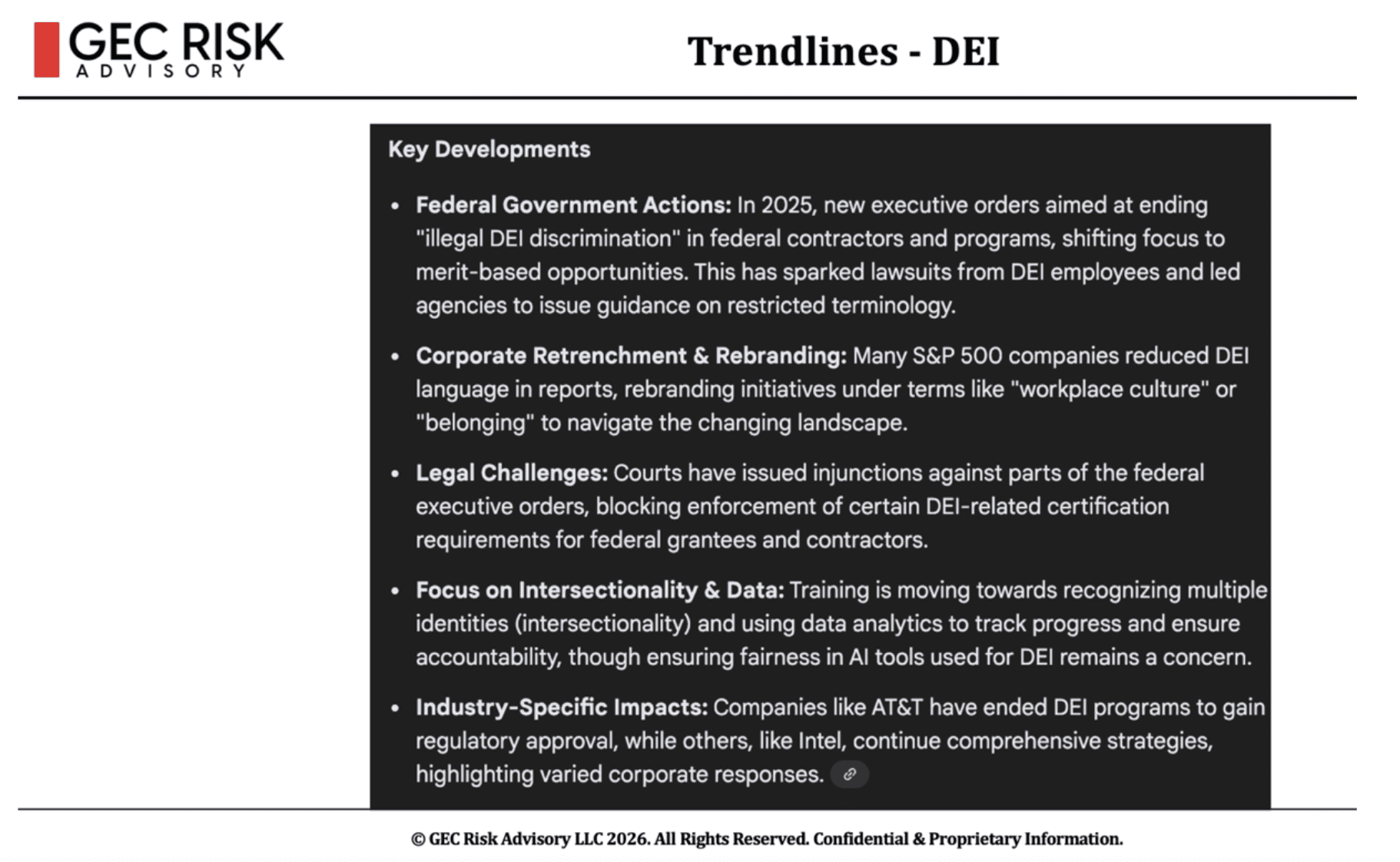
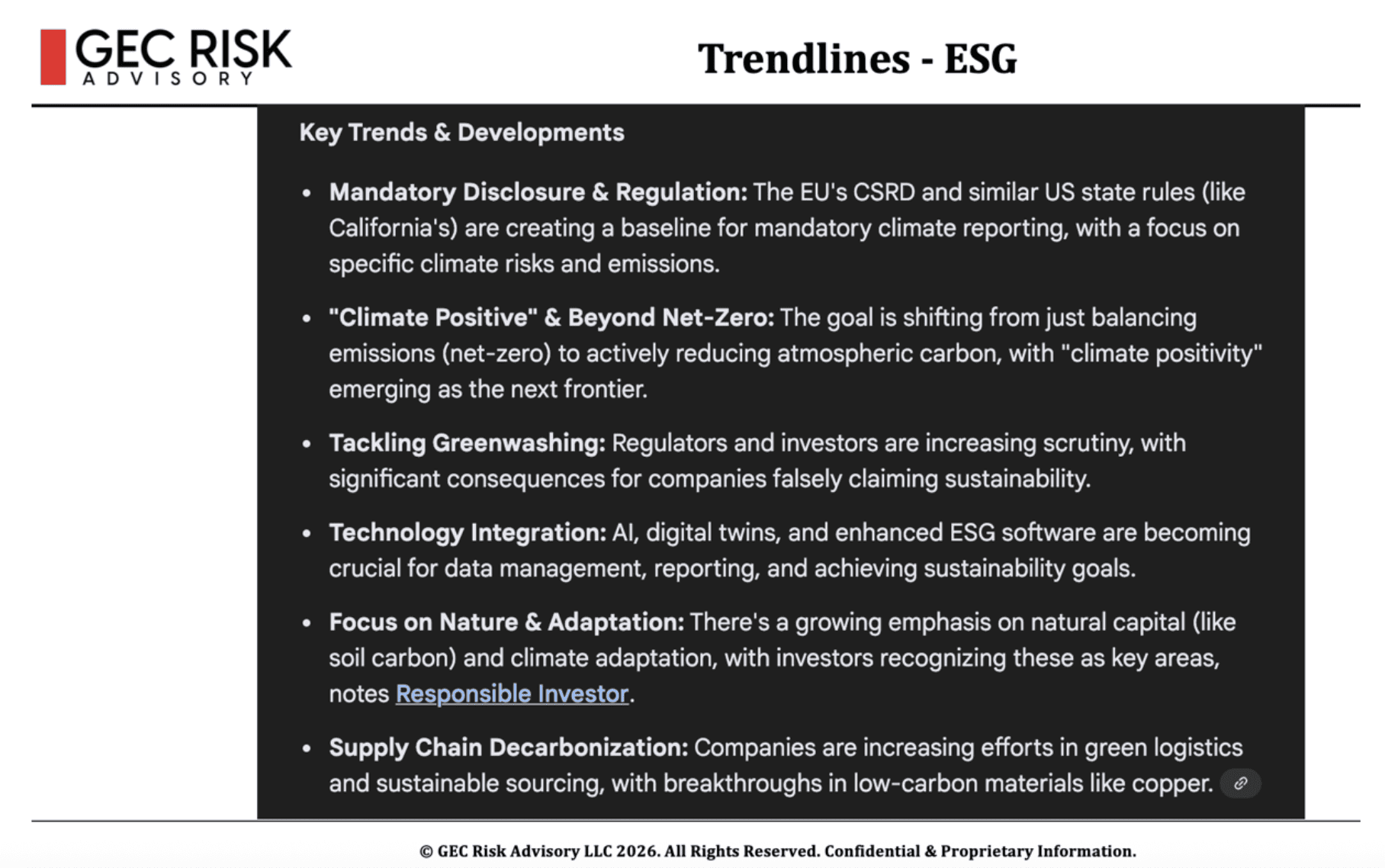
For a sense of the contents of my presentation, below are slides summarizing current trendlines in both the DEI and the ESG spaces (retrieved from a Google Gemini inquiry):
The discussion highlighted that, regardless of terminology, many organizations are continuing to address sustainability, human-capital, and governance topics through a mix of risk management, strategy, and stakeholder engagement. Participants compared regional approaches, reviewed current risk signals (geopolitical, environmental, and technological), and shared perspectives on operationalizing values through leadership practices and reporting lines. The group concluded by contrasting short-term shifts in emphasis with longer-term commitments that some companies are maintaining.