Trillions of dollars are about to move from one generation to the next, and most of it is headed to women. Coco Brown explores what that shift makes possible and why finishing Gloria Steinem’s work means building something new instead of waiting for a seat.
By Coco Brown
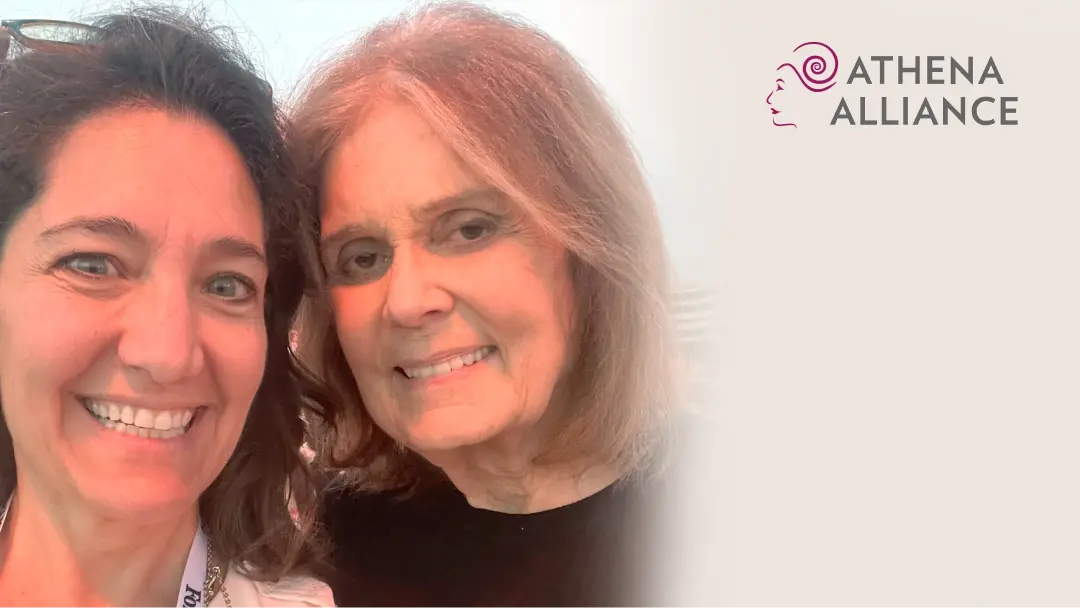
I have a photo of Gloria Steinem and me standing next to a camel. It was the Forbes 30/50 conference, where she was being honored, and I’d been invited to join. The evening was warm, the air smelled like hookah smoke, and somewhere behind us was the Abu Dhabi desert. It was a strange, cinematic setting to find yourself next to a living piece of history — the lights, the desert, the occasion itself — and then there she was, in her late eighties and appearing entirely at home. Down to earth in a way that made the whole surreal backdrop feel beside the point.
I don’t remember a single quotable thing she said to me that night. What I remember is the feeling of it: a woman who had spent her life organizing other women to get into rooms was, in that particular room, just a person, easy and present, while everyone around her treated the ground she stood on like it might be sacred. She didn’t perform the weight of what she’d built. She carried it, the way you carry something you’ve made peace with.
That’s the Gloria I want to start with, because the rest of this is going to sound like criticism of what she built, as though it wasn’t enough. I don’t mean it that way. What Gloria built is the sturdy foundation of a house I got to grow up in. But the house itself is no longer on steady ground. The terrain around it is shifting in a way that has us needing to move on.
Steinem’s generation fought for admission. My mother was part of that generation: one of the first women allowed to live off campus at Penn, one of the first two women awarded a Thoron Scholarship to Oxford — a scholarship she still recalls having to sign over to her then-fiancé, my father, because she couldn’t open a bank account without a male cosigner at the time. The fight was concrete. A bank loan, a mortgage, a spot in a classroom that had been closed to you by rule, not by chance. Title IX. The Equal Credit Opportunity Act. Decades of court cases and picket lines aimed at one answerable question: can a woman do this on her own, without a man’s approval?
Mostly, that fight was won. Not finished, not evenly distributed, not without ongoing enforcement, but won in the sense that matters most: no more required permission, no more rules that lock us out. Gloria’s generation fought the battles that laws can actually settle: writing them, or striking them down. My generation assumed the fight was over. It wasn’t.
In my early twenties, I didn’t think much about being a woman at work, past wanting to look older so people would take me seriously. It took until my late twenties to understand what had quietly become mine to confront: having the right to be in the room is not the same as being allowed to use it. Bias beats law whenever it wants to, and the ugliest part is that it’s rarely conscious. Nobody wakes up planning to hold a woman back. The bias isn’t aimed at you. It’s aimed at keeping things the way they’ve always been understood, and you happen to be standing where the norm used to go uncontested.
That was the first thing I got wrong: assuming an open door meant the room worked. We fought hard to be let into structures men built — the proverbial seat at the table. But the norms inside those structures are changing for everyone, and the climb itself is being dismantled in front of us.
I’ve held an executive title since I was twenty-nine, and I’ve spent my career building and pulling other women up alongside me. I was president, COO, and one of only three owners of a technical infrastructure company in Silicon Valley, as a non-technical young woman. I climbed a structure with real rungs. I believed it was solid because I’d watched people climb it. What none of us clocked in real time was that it was dissolving right as the newest people were being let onto it. Pensions went first, then tenure of any kind, then the premise of a company as a multi-decade container for a career. We kept giving the old advice — work hard, be loyal, find mentors and sponsors — because it was the only advice we had.
Younger workers of every gender are now inheriting a workplace with no single-company career, no clearly marked rungs to grab. But this lands differently on women, because we fought so long and hard to get access to these particular rooms. Arriving at a door your mother spent a career trying to unlock, only to find the room behind it was never built to last, is a sharper kind of disappointment.
Here is the opening most of that fight never anticipated: trillions of dollars are moving from Gloria’s generation to mine, and most of it is going to women. McKinsey projects that by 2030, American women are expected to control much of the $30 trillion in assets held by baby boomers — a transfer approaching the size of the entire U.S. economy. That money is the real unlock. If women use it to start their own companies, invest in the ones they want to see exist, and learn to make money make money, we stop needing a seat at anyone else’s table. We build our own, at the moment the existing ones are already coming apart.
Finishing this doesn’t mean building another door. We’ve treated “get in the room” as the whole project, in part because it was the clearest fight we knew how to have: a villain, a vote, a bill, a plaintiff. The next fight doesn’t have that shape, which is part of why we’ve been slow to name it. It means treating a career less like a structure you climb and more like a portfolio you build on purpose: impact, influence, and income spread deliberately across more than one place, instead of entrusted to one employer’s org chart.
Gloria organized people to get into the room. That was the fight of her generation, and it worked. What’s unfinished isn’t another door. It’s making sure none of us, especially the women who fought hardest to get here, keep mistaking the room for the whole plan. No room stays standing forever. The building Gloria’s generation opened the door to is already shifting under the next generation’s feet. The least we owe them is to stop pretending otherwise.
Read Coco’s tribute to Gloria Steinem on LinkedIn