
Let us know what you think on the LinkedIn version of this newsletter!
The February 2026 monthly meeting of the Athena Alliance / GEC Risk Advisory LLC Salon “Ripped from the Headlines” focused on analyzing current geopolitical trends, tensions and realignments and their impact on global business, with particular attention to shifting alliances between major powers and the declining trust in institutional leadership.
Participants discussed how businesses are responding to these changes, with some companies taking public stances on important issues while others maintain a lower profile. The conversation explored how climate change, supply chain disruptions, and political instability are interconnected challenges that businesses must navigate, with several participants sharing personal experiences about immigration and family history to provide context for the current global situation.
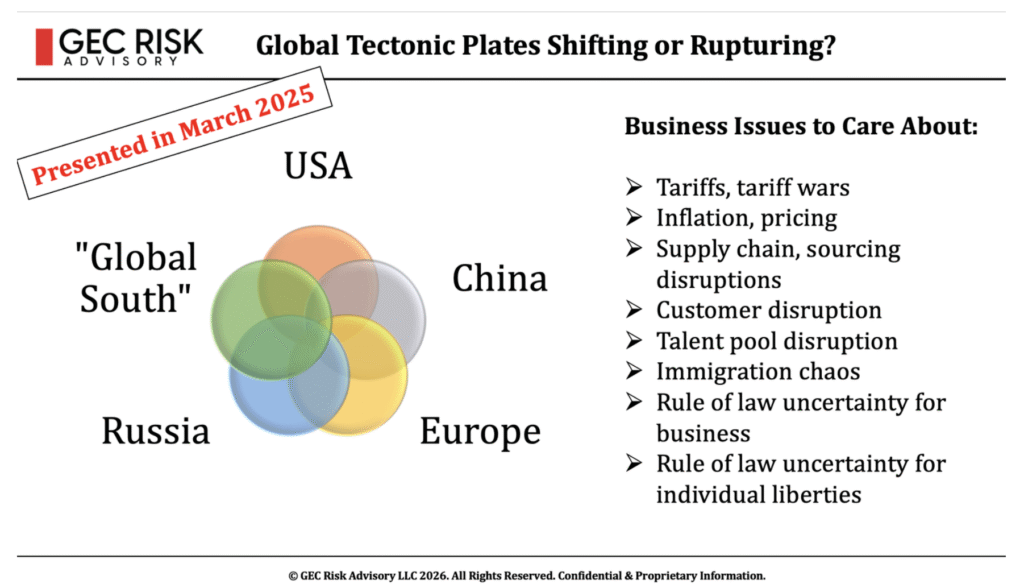
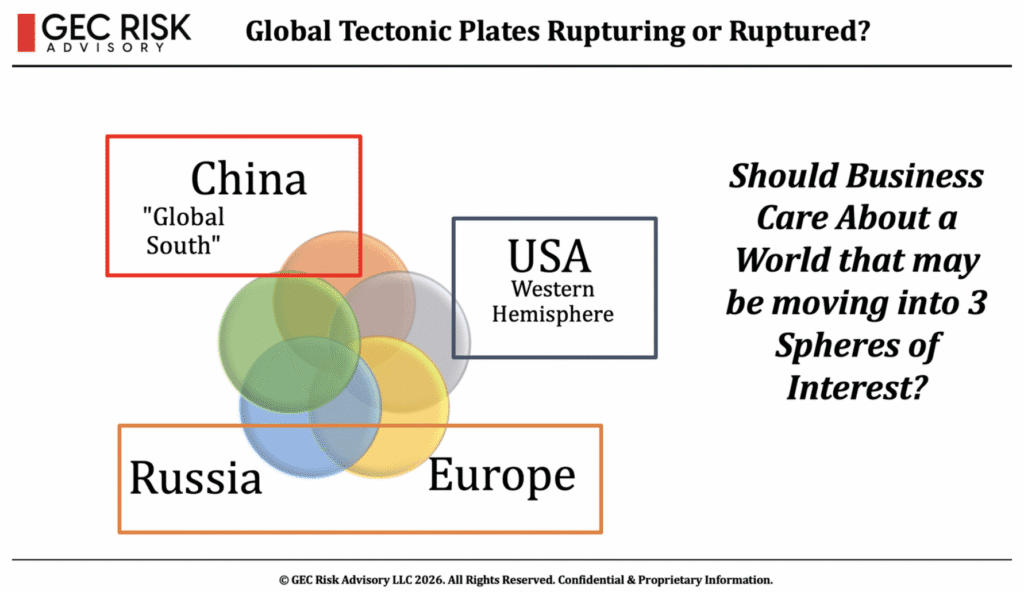
I shared a slide from a geopolitical developments salon we did in March 2025 (see first slide below) and posed the question as to whether we had moved on from that snapshot to something that may be more akin to a world divided into three spheres of influence (see second slide below).
The discussion included reflections on the importance of long-term thinking in business and leadership, particularly in contrast to short-term political and economic dynamics that are taking place and on which some decisions are based.
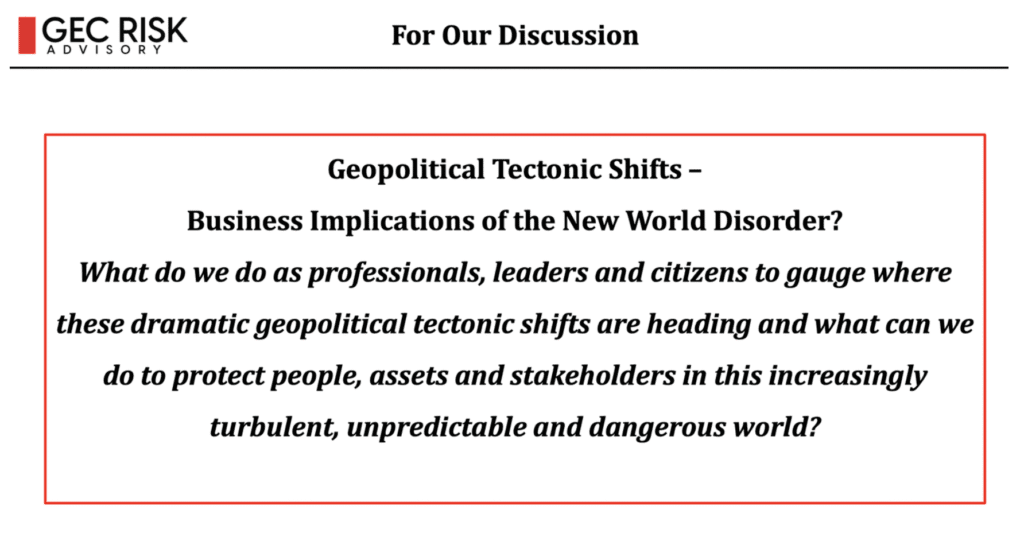
The overall question we addressed after the presentation of the headlines, developments and trends, was the following:
Using a variety of resources including the Financial Times, The New York Times, The Economist, Council on Foreign Relations, Eurasia Group , World Economic Forumand others, I presented slides showing recent international news stories on the shifting geopolitical landscape. Included in these shifts are those of Canada moving more towards China and Europe due to strained U.S. relations, and urgent developments taking place in Europe to enhance its self-defense capabilities in the face of declining support and confusing and sometimes contradictory US foreign policy.

I offered news clips on Marco Rubio’s speech at the Munich Security Conference, noting its mixed reception and the ongoing tensions between Europe and the U.S. on the Russia Ukraine war. I also addressed significant developments in China, including Xi Jinping’s recent profound military purges, and the rise of a populist, right-wing government in Japan led by Prime Minister Fumio Kishida. The discussion also touched on the decline of democracy worldwide and its implications on global stability.
I presented a comprehensive overview of global geopolitical risks and challenges, highlighting issues such as U.S. political instability, cyberattacks, and conflicts in regions like the Middle East and Africa. I emphasized the importance of understanding these risks for businesses and suggested that the current global landscape may be moving towards three spheres of interest dominated by China, the U.S., and Europe.
A participant discussed the interconnectedness of climate change, supply chain disruptions, and geopolitical stability, urging businesses to take collective action on sustainability and ESG initiatives. Both participants agreed on the need for businesses to engage proactively in addressing these challenges, though they expressed skepticism about the current willingness of business leaders to speak out publicly.
The group discussed global challenges and scenario planning in business. A participant emphasized the importance of grassroots efforts and microcosms in making a difference, while also acknowledging the need for scenario planning in response to geopolitical risks. Another participant challenged the idea of “biding time” as a solution to current challenges, highlighting concerns about government non responsiveness and the rapid pace of technological change. The discussion touched on the potential decline of the West and the rise of China, as well as the need for business leaders to be more courageous in navigating these complex issues.
The meeting also focused on the current state of business and society, with one participant sharing her personal experience as an immigrant from Africa who came to this country 30 years ago and who has reached high levels of leadership in business and technology and the challenges her children nevertheless face due to the current political climate.
Participants discussed the impact of greed and short-term thinking in business, as well as the importance of trust and long-term leadership. The group explored how companies and individuals can navigate these challenging times by focusing on their values and maintaining civility. We discussed who excellent examples of businesses that are generally navigating these complex times successfully while holding on to their values – the NFL’s not bowing to political pressure on the programming of Bad Bunny in the Superbowl Halftime Show and Anthropic’s public stance on the need for AI risk awareness and even possible regulation.
The group agreed that it was best for us as citizens, decision-makers and members of leadership teams or boards to maintain a high level of awareness and alertness about the world around us by consuming trustworthy and factually reliable sources of geopolitical information and analysis including the The Economist, Financial Times The New York Times and newsletters such as those from Axios and SEMAFOR.